

This article is provided for educational and informational purposes only. It does not constitute legal, financial, or tax advice, and no attorney-client relationship is formed by reading it. Laws, regulations, official guidance, and related information vary by jurisdiction, change frequently, and may have changed or become outdated since publication. Always verify current information with authoritative sources and consult a qualified professional about your specific circumstances. The author and publisher assume no liability for actions taken based on this information.
- Match the document to the citizenship history
- A full-validity passport is not necessarily an unexpired passport
- Prepare the physical evidence and copies for a passport application
- If there is no qualifying birth certificate
- If citizenship is claimed through a parent
- Choose an initial certificate or the correct replacement route
- Sources
Key Facts
- Passport evidence: The passport rules distinguish primary evidence from secondary records used when the usual documents are unavailable.
- Citizenship certificates: A Certificate of Citizenship and a Certificate of Naturalization are both recognized forms of citizenship evidence for passport applicants born abroad.
- Initial certificate: Form N-600 documents qualifying citizenship already acquired or derived under the applicable law.
- Replacement certificate: Form N-565 is the USCIS route for qualifying replacement naturalization or citizenship documents.
- Birth abroad: A Consular Report of Birth Abroad records citizenship at birth abroad; it is not a replacement for proof of a later naturalization.
Proof of U.S. citizenship starts with the document being requested and the reason it is needed. Before ordering a replacement or filing a new application, identify the receiving agency, the citizenship history, and the records already available.
For a passport application, federal regulations place the burden of proving citizenship or noncitizen nationality on the applicant and require documentary evidence. A foreign-born applicant may use a Certificate of Naturalization, Certificate of Citizenship, or Consular Report of Birth Abroad, or other required evidence establishing the applicable citizenship claim.
This guide focuses on choosing and obtaining evidence, rather than deciding whether every possible citizenship claim succeeds. The U.S. immigration overview provides broader context for the agencies and legal processes involved.
Match the document to the citizenship history
A qualifying U.S. birth certificate is the usual primary birth evidence for a person born in the United States applying for a passport for the first time. The passport regulation requires the applicant’s full name, birth date and place, the parents’ full names, the official custodian’s signature, the issuing office’s seal, and a filing date within one year of birth.
A hospital souvenir or hospital birth record is not the same as the civil birth certificate described in that rule. Hospital records instead appear among the possible secondary records.
For a person born abroad, the evidence must establish the requirements of the citizenship law or treaty being relied on. A parent’s citizenship document can be part of that evidence, but it does not by itself establish every requirement of the child’s claim.
A Consular Report of Birth Abroad, often called a CRBA, is a State Department record documenting citizenship at birth abroad. The registration process requires satisfactory evidence of birth, identity, and nationality, including the parent’s citizenship and relevant U.S. physical presence.
Citizenship certificates require attention to the legal route as well as the document’s title. The N-600 process addresses acquired or derived citizenship, while a separate statute provides a naturalization process for certain children residing abroad that also ends with a Certificate of Citizenship.
The narrower Certificate of Naturalization guide addresses that document’s meaning and replacement issues. Read the title printed on an existing certificate before choosing a form based on an informal description such as “citizenship papers.”
A full-validity passport is not necessarily an unexpired passport
Federal law gives a passport issued to a U.S. citizen the same force and effect as a citizenship or naturalization certificate during its validity period, provided that period is the maximum authorized by law. The same statute recognizes a qualifying Report of Birth Abroad as citizenship proof.
The State Department’s current in-person passport checklist separately accepts a full-validity, undamaged U.S. passport as primary citizenship evidence, including one that was previously valid for the full period. In that checklist, “full validity” describes the duration for which the passport was issued; it does not mean the passport must still be unexpired.
Do not turn that passport-application instruction into a rule for every transaction. When another agency requests proof, check whether it accepts an expired passport, requires an unexpired document, or needs a different form of evidence.
Likewise, keep identity, residence, and citizenship questions separate when gathering records. An agency asking for citizenship evidence may still ask for other documents addressing a different fact.
Prepare the physical evidence and copies for a passport application
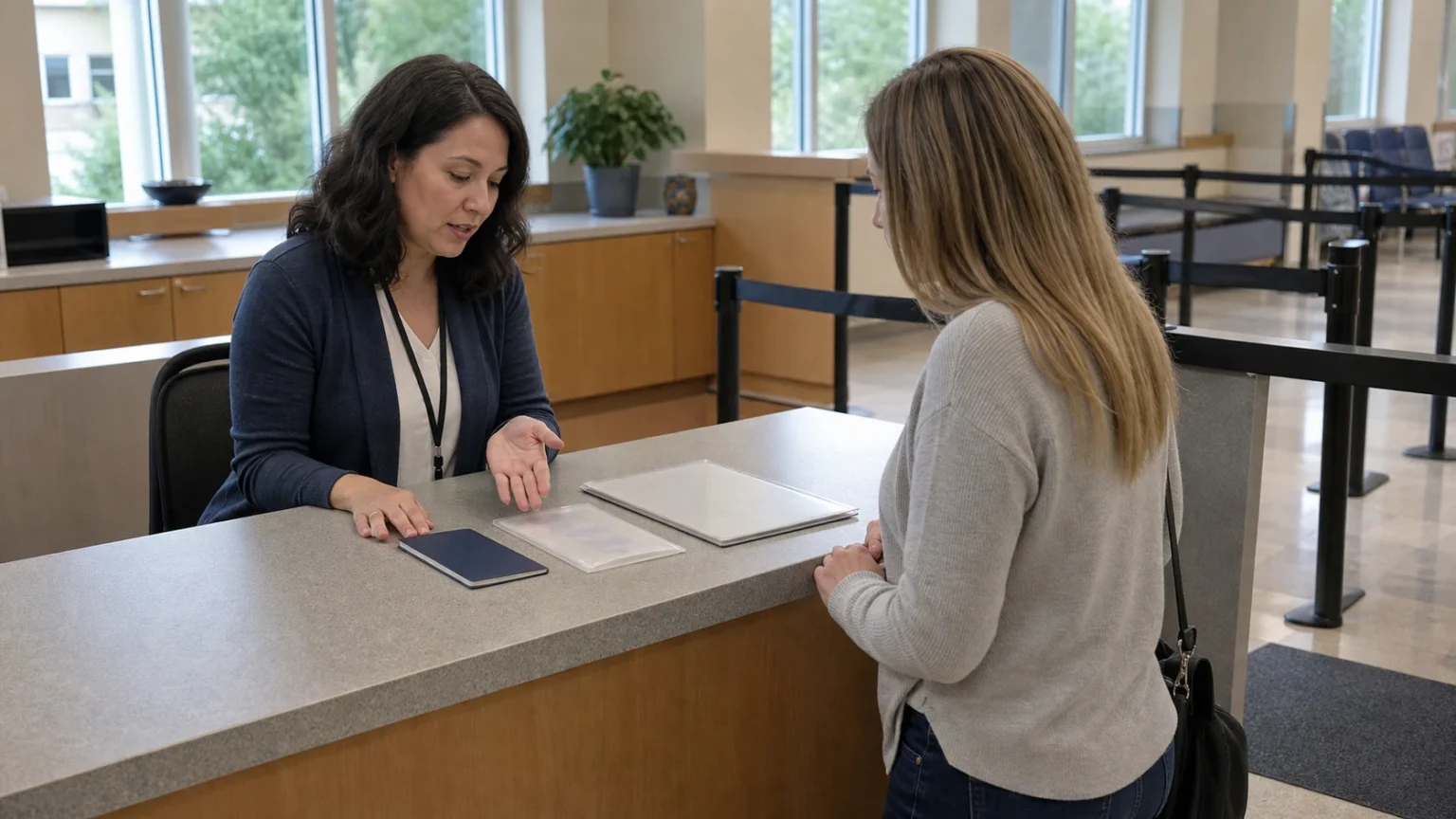
For an in-person passport application, State currently instructs applicants to submit the citizenship document and a photocopy of its front, plus a copy of the back if it contains printed information. Copies must be clear, single-sided, and on standard white 8.5-by-11-inch paper.
An electronic copy of a birth certificate is not accepted for that submission. If the original record is unavailable, the instructions direct applicants to obtain an official replacement from its issuing office; an acceptable certified copy has the issuing office’s seal or stamp.
For foreign-language citizenship evidence, the current State checklist calls for a professional English translation and a notarized translator’s letter addressing accuracy and the ability to translate the document. Do not assume another agency’s translation instructions use exactly the same certification requirements.
Keep a readable copy of the records you submit and a list of what was included. This helps you respond to a later question without reconstructing the entire package from memory.
If there is no qualifying birth certificate
The passport regulation permits secondary evidence when a U.S.-born applicant cannot produce the qualifying birth certificate. Examples include hospital, baptismal, medical, and school records, as well as affidavits from people with personal knowledge of the birth.
These records should be close in time to the birth: the regulation generally describes documents created no more than five years afterward. A recently written family account does not automatically replace the evidence the Department needs.
State’s current checklist uses a delayed birth certificate or a Letter of No Record together with the appropriate early records. A delayed certificate is one filed more than a year after birth; its supporting records and birth-attendant signature or parental affidavit affect what additional evidence the checklist calls for.
A Letter of No Record should identify the applicant and birth date, the years searched, and the absence of a birth certificate on file. It documents the missing civil record; it is not by itself a substitute for evidence establishing the birth.
Form DS-10, the Birth Affidavit, is one possible part of the secondary-evidence process. Follow the combination of records required for the situation rather than treating any one early-life document as universally sufficient.
If citizenship is claimed through a parent
For citizenship acquired at birth abroad, State’s evidence checklist calls for the foreign birth certificate identifying the parents, evidence of the relevant parent’s citizenship, applicable marriage evidence, and a statement of the parents’ residence history before the birth. The applicable law determines which residence or physical-presence facts must be proved.
Automatic citizenship after birth involves a different set of facts. Under the current general statute, the conditions include a U.S.-citizen parent, a child under 18, and U.S. residence in that parent’s legal and physical custody following lawful admission for permanent residence.
The statute has additional provisions for qualifying adopted children and certain children of military or federal personnel residing abroad. Do not apply the ordinary residence description without checking whether an applicable exception or different historical law governs the claim.
For the ordinary parent-based passport evidence package, State asks for records addressing permanent-resident status, custody, and actual residence with the citizen parent. It expressly distinguishes a green card from proof that the child actually lived in the United States and requests at least two documents of that residence.
School, day care, medical, housing, or similar records can therefore answer a different question from the immigration card. Build a dated chronology showing when each required fact existed rather than relying only on the parent’s naturalization date.
Choose an initial certificate or the correct replacement route
N-600 is for an initial Certificate of Citizenship based on a qualifying acquired or derived citizenship claim. The applicant must establish the claim by a preponderance of the evidence; filing the form does not independently create citizenship.
N-565 serves a different task: obtaining a qualifying replacement citizenship or naturalization document. The replacement regulation covers lost, mutilated, or destroyed papers and specified name-change circumstances; the current form instructions determine the evidence for the request.
If an N-565 request is filed online, USCIS currently instructs the applicant to mail the original document to the designated service center afterward when the original is part of the request. A lost-document claim instead needs the evidence appropriate to the loss; it cannot include an original that no longer exists.
For a CRBA, the State Department—not USCIS—handles amended or replacement reports under its own written-request procedure. For a birth certificate, begin with the issuing vital-records office identified by the passport evidence instructions.
If a passport or CRBA was issued previously but cannot be submitted with a new passport application, State offers a file-search request process. Check its current instructions and possible search fee rather than assuming a file search is available for someone who never had either record.
Before filing, compare the document’s exact name, issuing agency, reason it is missing or inaccurate, and the evidence requested for the replacement ground. That short check helps separate a document-replacement problem from an unresolved citizenship claim.
Sources
- Department of State: citizenship evidence for a passport
- 22 C.F.R. Part 51, Subpart C: citizenship and nationality evidence
- 22 U.S.C. § 2705: documentary proof of citizenship
- USCIS: Form N-600
- 8 C.F.R. Part 341: Certificates of Citizenship
- USCIS: Form N-565
- 8 C.F.R. Part 343a: replacement citizenship and naturalization papers
- 22 C.F.R. Part 50: nationality and consular birth records
- 8 U.S.C. § 1433: naturalization of certain children residing abroad
- 8 U.S.C. § 1431: automatic citizenship after birth